Home / Products / Concealed Ceiling-Recess Blinds
Shading designed into the ceiling, not bolted on after
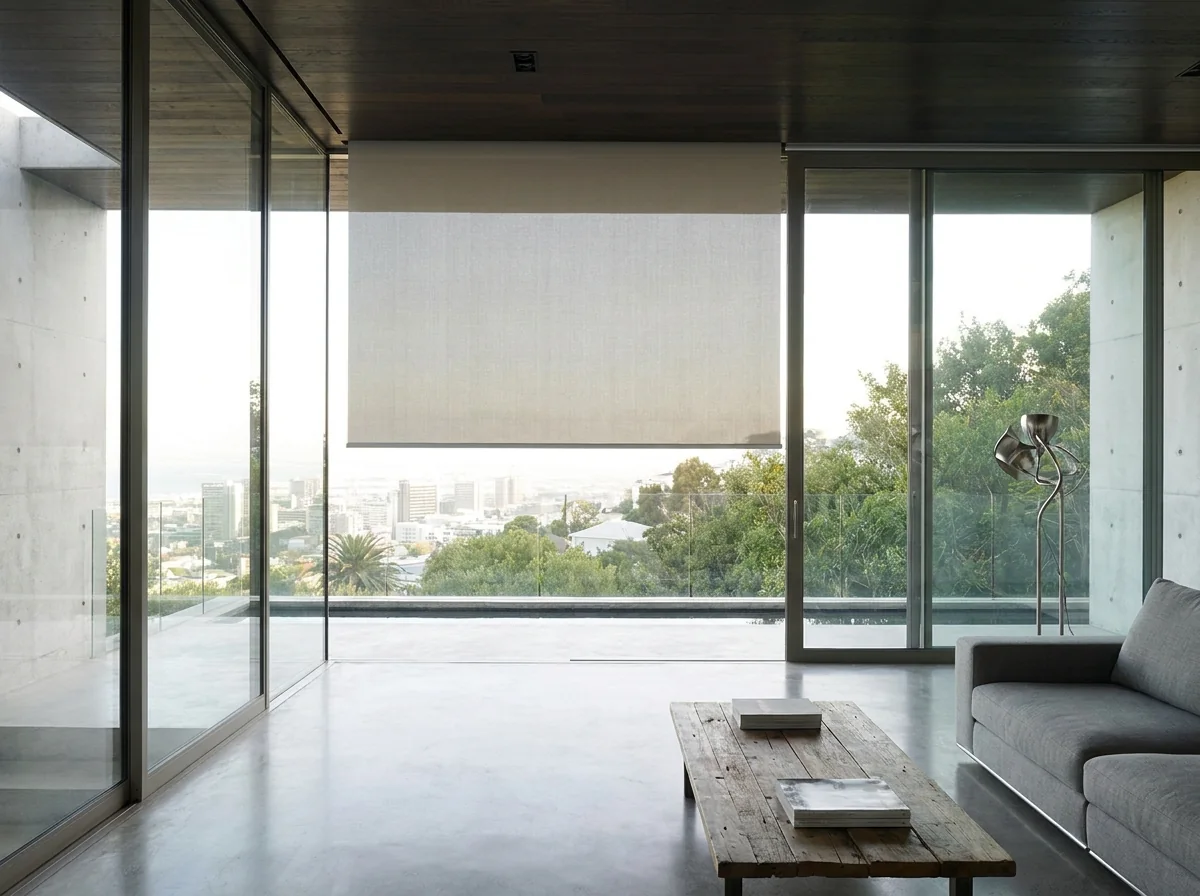
For Higgovale's architect-designed and renovated homes — frameless glass, double-volume voids, minimalist detailing — a blind that drops from a slim ceiling slot instead of a bracket on the wall, so a raised window shows nothing but glass and mountain.
Built for the glass Higgovale's renovations are chasing
Higgovale's steep stands mean orientation and the view vary street to street, but the ambition is often the same: floor-to-ceiling glass, frameless corners, a double-volume void that a bracket-mounted headrail would visually interrupt. A concealed system drops the fabric from a slim slot recessed into the ceiling or a plastered bulkhead, so the hardware disappears entirely — raised, the opening reads as glass and view, nothing else.
Best planned early, not bolted on after
The earlier this is in the drawing stage, the cleaner the result — the recess depth (roughly 110–150mm depending on the tube and fabric drop) needs coordinating with downlights, aircon slots and curtain pelmets before the ceiling is closed up. A renovation or new build is the ideal moment. Retrofit is still possible on an existing home, using a surface-mounted bulkhead or a slim cassette pelmet colour-matched to the ceiling, though the finish is never quite as invisible as a system planned from the start.
Almost always motorised
Hand-reaching into a ceiling slot defeats the purpose of a concealed system, so these are motorised as standard — a quiet tubular motor on a wall switch, remote or app. On a heritage-listed structure, work that's entirely inside the ceiling void is a furnishing decision and needs no permit; where the recess requires structural changes to a facade element, we flag that plainly rather than assume it through. Where the outside of the building is not yours to alter — a sectional-title flat in Tamboerskloof, or any City Bowl block where a body corporate signs off on the exterior — the shading has to happen indoors, and this is the most discreet indoor answer we fit. In a flat whose ceiling is already closed up, that means the slim cassette pelmet described earlier rather than a true slot.
What a concealed system costs
Concealed and ceiling-recessed blinds are priced per square metre installed, at R1,600 to R3,000 for a manual system and R3,200 to R5,000 motorised. The premium over a surface-mounted blind is not the fabric. It is the head detail: a slot, a plaster-in cassette or a bulkhead recess that hides the tube completely, and the coordination that goes with getting it right.
That coordination is also why timing changes the number. Where a ceiling is still open or a bulkhead is still being built, a recess is straightforward. In a finished room, forming one is building work and belongs in someone else’s quote, not ours — we will say so plainly rather than promise a neat result that a completed ceiling cannot give. Small openings carry a minimum charge, and the exact per-window price follows the free measure.
Who this suits
Architect-designed and renovated homes with frameless glass, double-volume glazing and minimalist detailing.
Timing matters
Best planned at the drawing stage; a retrofit bulkhead is possible on an existing home.
- Recess depth confirmed against your exact system at quote stage
- Coordinated with downlights, aircon slots and pelmets
- Motorised as standard — wall switch, remote or app
- Retrofit bulkhead option for existing homes
Renovating or building?
The earlier we're in the drawing stage, the cleaner the finish. Free consultation, no obligation.