External venetian blinds
Aluminium slats outside the pane, tilted through the afternoon. Full heat rejection while the view stays open between the slats — the only product that solves a west wall without also blinding it.
Most shading arguments in this suburb are really arguments about arithmetic. Here are the numbers that decide what your windows need — worked out for the slope you actually live on, and free to use whether you ever speak to us or not.
Want it in one file? Save the PDF version — the same guide, 0.9 MB.
Cape Town sits at roughly 33.9 degrees south. That single figure fixes almost everything a window here will experience, and it produces two numbers worth committing to memory.
At the December solstice, the sun at its highest stands about 79 degrees above the horizon — very nearly straight overhead, leaning a few degrees into the southern sky. At the June solstice the same midday sun manages only about 33 degrees, and it sits due north. Halfway between, at the two equinoxes in March and September, it reaches roughly 56 degrees.
Those three altitudes are not a rule of thumb. They fall straight out of the geometry of latitude, and you can reproduce them yourself in a minute on any public solar calculator. Everything that follows is the consequence of them.
| Date | Height at midday | Where the sun sits |
|---|---|---|
| 21 December | about 79° | almost overhead, a touch south |
| 21 March / 21 September | about 56° | due north |
| 21 June | about 33° | due north, and low |
There is a second habit worth breaking. Solar noon in Cape Town is not twelve o'clock. South African Standard Time is set on the 30°E meridian, and this city sits about 11.6 degrees west of it, which pushes true midday roughly three-quarters of an hour late. Add the seasonal wobble in the sun's own timekeeping, and the actual high point of the day lands somewhere between about half past twelve and one o'clock, depending on the month. South Africa keeps no daylight saving, so that drift is the only one you have to allow for.
The practical consequence: when someone in Higgovale says the four o'clock sun is unbearable, they are describing a sun that is barely three hours past its peak — not five.
Take a north-facing window with something projecting above it — an eave, a balcony slab, a pergola beam. At solar noon the shadow that overhang casts down the wall is simply its depth multiplied by the tangent of the sun's altitude. One measurement, one calculator.
Say the projection is 900 mm, which is a common enough figure on the renovated stands up here.
People read that third line as a failure. It is the opposite. On a north wall in a winter-rainfall city, June sun arriving deep into the room is the free heating you paid for when you bought a north-facing house. An overhang that switches itself off in winter is doing precisely the job a fixed overhang exists to do.
Which is why the honest recommendation for most north glass in Higgovale is not a heavy product. It is something adjustable and light-handed — a tilting slat you can angle down in February and open flat in July, or a sunscreen cloth fine enough to leave the mountain readable. The elevation is already half-solved by the building.
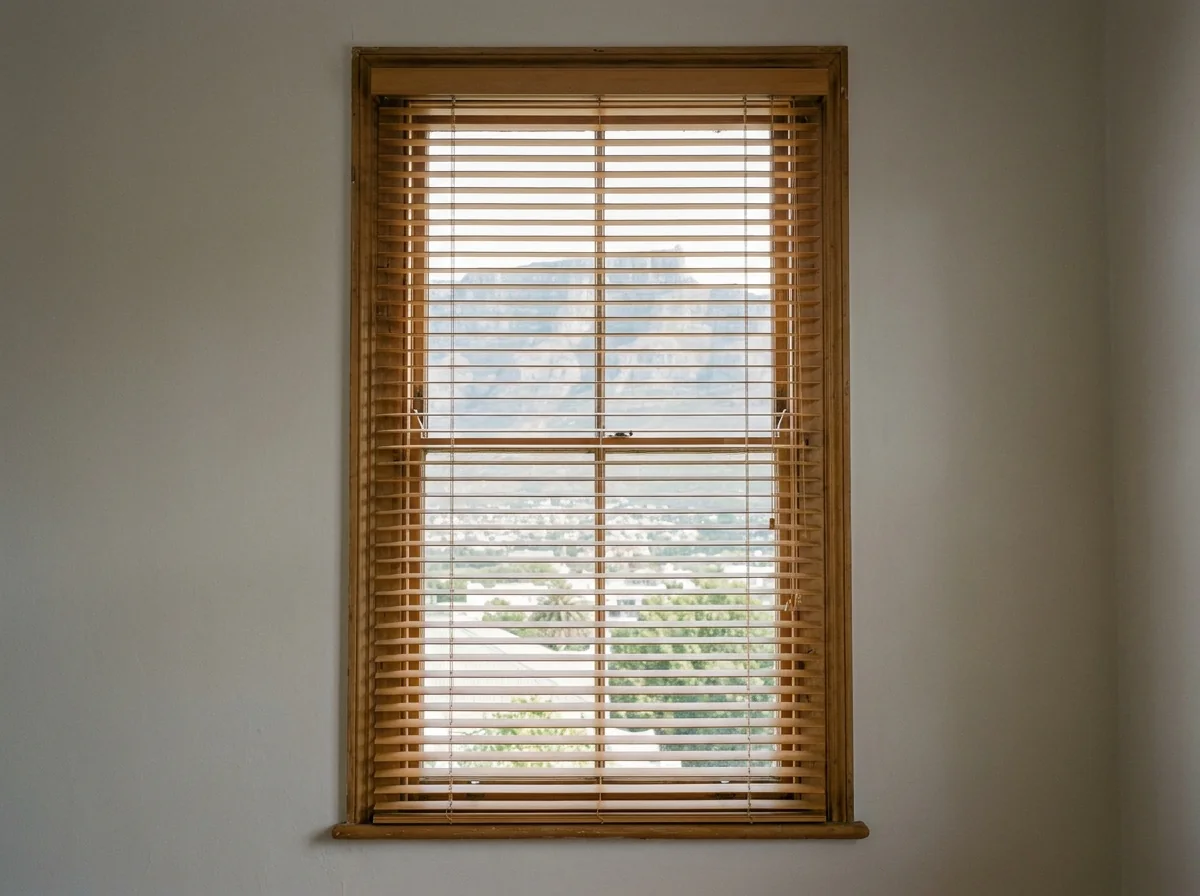
Now do the same sum on a west wall, and watch it fall apart.
In high summer the Cape sun does not set in the west. It sets at a bearing of roughly 241 degrees — well round into the south-west — and it takes its time getting there. On a January afternoon it is still about 35 degrees up at five o'clock, and around 10 degrees up at seven. Those two figures are the whole problem in miniature.
Feed 10 degrees into the same formula and a 900 mm overhang buys you about 160 mm of shade. Not a metre. Not half a metre. Roughly the width of your hand. There is no horizontal projection of any sensible depth that will shade a west window against a low sun, because the sun is no longer above the window — it is in front of it, aimed straight down the glass.
So the west elevation has to be solved in the plane of the glass rather than above it. And there the physics gets blunt: a fabric hanging on the inside of the window has already lost most of the argument. Sunlight has crossed the pane, been absorbed by the cloth, and is now warming the air in your room. A slat or a screen hanging outside the glass intercepts the same energy while it is still outdoors, and lets it convect away into the open.
That is why external shading is the premium tier here, and why we lead with it on a hard west elevation rather than treating it as an upsell:
Aluminium slats outside the pane, tilted through the afternoon. Full heat rejection while the view stays open between the slats — the only product that solves a west wall without also blinding it.
Rigid slats rolling down the outside of the opening for complete sun, heat and glare control on demand. A shading product here, not a security claim.
Mesh running in zipped side channels, so it stays flat instead of flapping. The sensible outdoor choice on a stand exposed to the funnel.
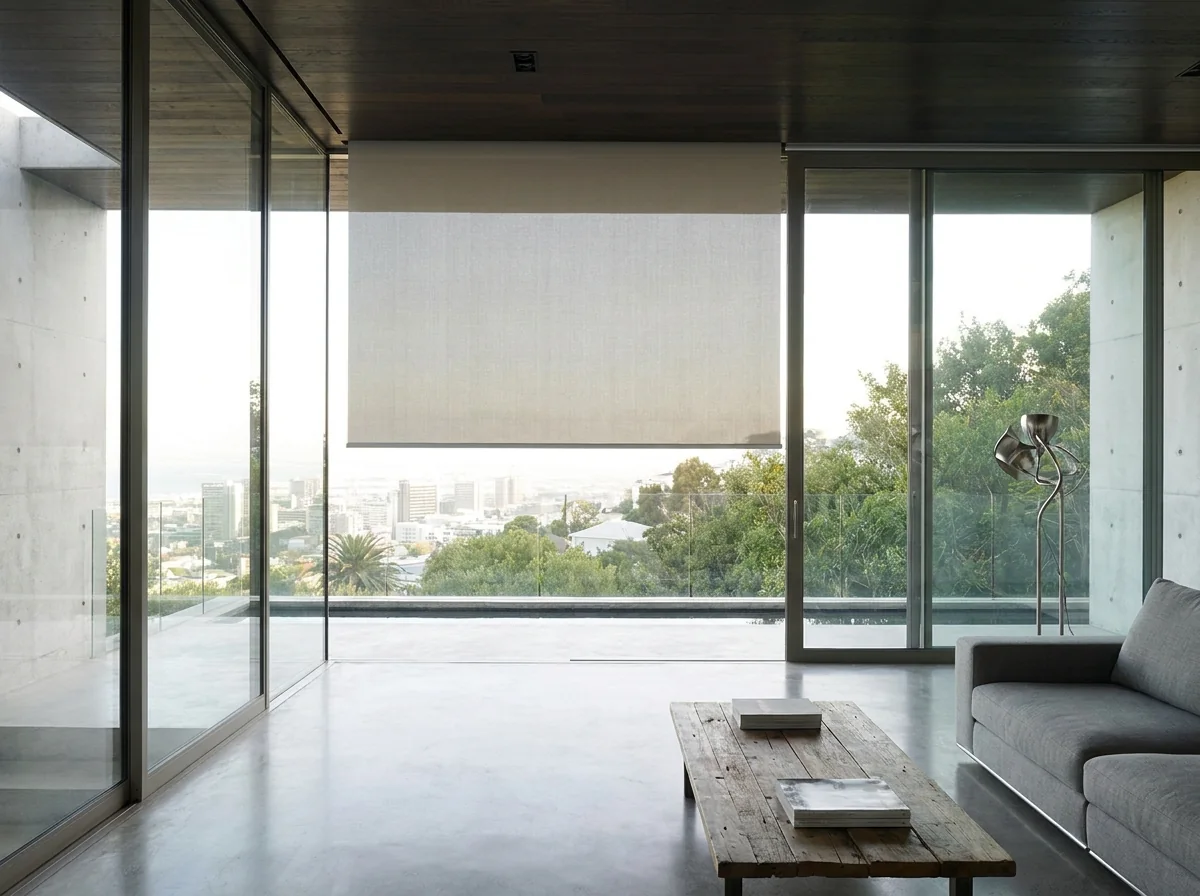
Inside the glass, the useful move on a west window is a fine sunscreen weave rather than a heavy blockout — glare drops, the harbour survives, and the room does not go dark at half past six in midsummer.
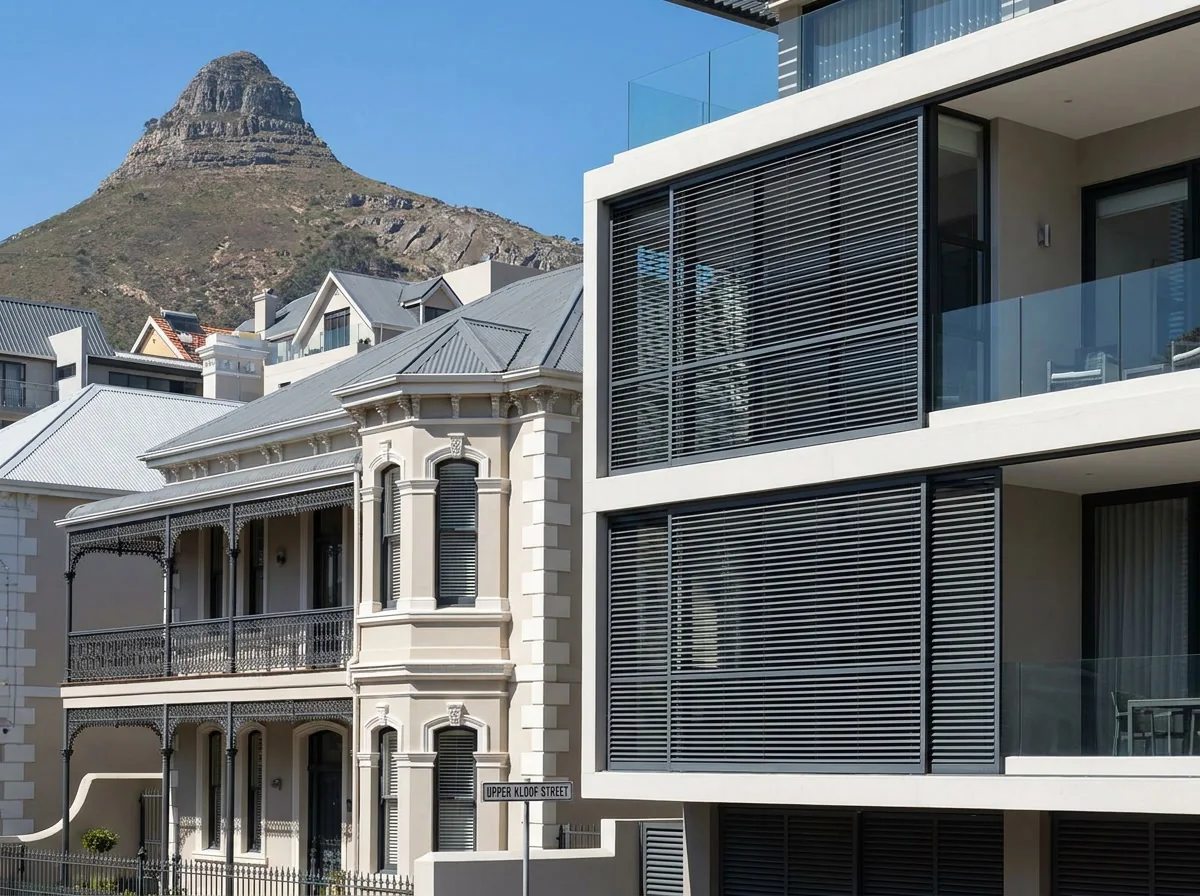
Every published sunset time is a sea-horizon time. It assumes a flat rim of ocean at zero degrees. Higgovale does not have one. The suburb is built into a slope with mountain shoulders standing above it, and on the upper streets the sun disappears behind rock well before the almanac says it should.
This cuts both ways, and it is worth knowing which way it cuts for your house before you spend money.
A stand whose western skyline is blocked by a high ridge may lose the last forty minutes of summer sun outright — in which case the west window that everyone assumes is a disaster is actually quite civil, and the money is better spent elsewhere. A stand that looks out clear over the lower Bowl to the sea keeps every minute of it, and needs the full external answer described above.
Pick a clear afternoon in January and one in June. Stand at your worst window and note the clock time the direct sun leaves the floor. That single observation, repeated in two seasons, tells a fitter more about your house than any amount of guessing from a floor plan — and it is free. Bring both times to the measure.
The same logic explains the other Higgovale complaint we hear often: rooms that stay cold. A room screened from the north by the building's own mass, or shaded by the slope behind it, gets very little winter gain and loses heat steadily through single glazing on a wet July night. That is not a glare problem and no amount of blockout will fix it. It is an insulation problem, and the answer is a cellular blind whose trapped air cells sit between the room and the cold pane.
Sun every single day of the year, high and brief in summer, low and generous in winter. If there is any overhang at all, half the work is done. Specify for adjustability and for glare on a desk or a television, not for brute heat rejection.
In midsummer the sun rises at about 119 degrees — south of east, out over the lower Bowl — and it climbs fast. By midwinter it has swung round to roughly 61 degrees and comes up behind the higher ground to the north-east, which means winter mornings here arrive late and gently. The practical upshot is that an east-facing bedroom is a summer problem only, and the thing it wants is genuine darkness before six in the morning, not clever light control.
Direct sun almost never reaches a south wall at this latitude, apart from a short spell either side of the December solstice, early and late in the day. A south room's enemies are damp, cold and the flat grey light that makes a room feel unfinished. Insulating cell blinds, pale fabrics, and nothing that further reduces the little daylight the wall receives.

Stairwell windows, high clerestories and the glazing above a double-volume void tend to get skipped at quoting stage and then cause every complaint afterwards, because nobody can reach them. If a window is out of arm's reach it should be motorised, full stop — that is a reach decision rather than a luxury one.
From about October to March the south-easter runs hard through the Peninsula, and the upper City Bowl catches it where the airflow is squeezed between the mountain and the sea. It is a summer wind, and it arrives in exactly the season you would most like an awning open.
Nothing about that changes which fabric you choose. It changes brackets, fixings, arm geometry and control. Three questions decide whether an outdoor product survives its first summer here:
Every external product has a wind speed beyond which it should be retracted, and no supplier who tells you otherwise is being straight with you. The right conversation is about what happens automatically when that speed is reached — not about pretending the number does not exist.
This matters more in Higgovale than in most suburbs, because the housing stock runs from restored Victorian and Edwardian work at the lower end of the slope to recent architect-built glass higher up, often within a block of each other.
Two things are worth knowing, and neither is complicated.
Section 34 of the National Heritage Resources Act, 25 of 1999, protects any structure older than 60 years: it may not be altered or demolished without a permit from the relevant provincial heritage resources authority, which in this province is Heritage Western Cape. Sixty years is a rolling threshold, so a 1960s house that was outside it a decade ago is inside it now.
The City of Cape Town's Development Management Scheme also provides for Heritage Protection Overlay Zones, and parts of the upper Table Valley fall inside one. An overlay adds its own requirements on top of the national act. Whether your erf is affected is a matter of public record and worth confirming before you commit to anything visible from the street.
Where the line falls in practice:
What we can do is supply the product data, dimensions and slim, quiet-coloured profiles that a heritage submission asks for, and tell you plainly when we think a permit is likely. What we cannot do — and nobody selling blinds can — is tell you it will be approved. That decision belongs to the authorities and, on a graded property, to your heritage practitioner.
None of these need a professional. All of them make the consultation shorter and the quote more accurate.
A free in-home measure, every opening recorded with its orientation and overhang, and a written per-window quote afterwards. No obligation, and no charge whether you order or not.
A line or two about the rooms, and the products you have in mind, is enough. One of our expert consultants will contact you shortly to arrange your free in-home measure.
Every figure above is either a published value or something you can reproduce yourself. Where we were not confident of a fact, we left it out rather than round it into something that sounded better.
The recommendations, the arithmetic worked through above and the opinions in this guide are our own, offered free and without obligation. Nothing here is a heritage approval, a structural opinion or a guarantee about any particular building — those belong to the relevant authority and to your own professional team.
For later: download this guide.